arduna.world

NB: Arduna is confidential as it is still in development, and will episodically reveal an alt history that participants will be cast into through live events and supper clubs. In July 2026, Baraka Obscura introduced the first move of the arduna community: to become strategically illegible to dominant reality while beginning to construct other parallel worlds.

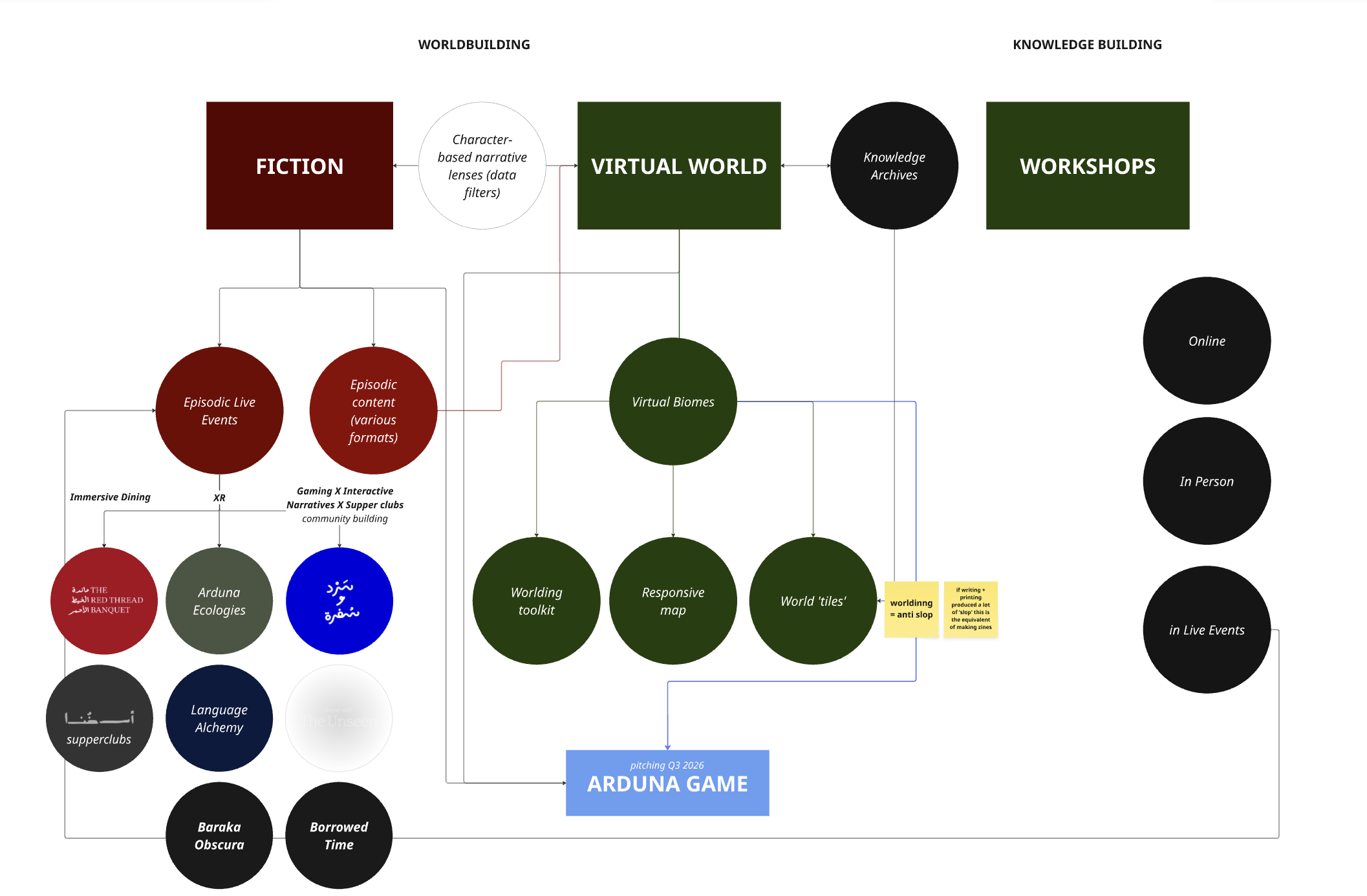
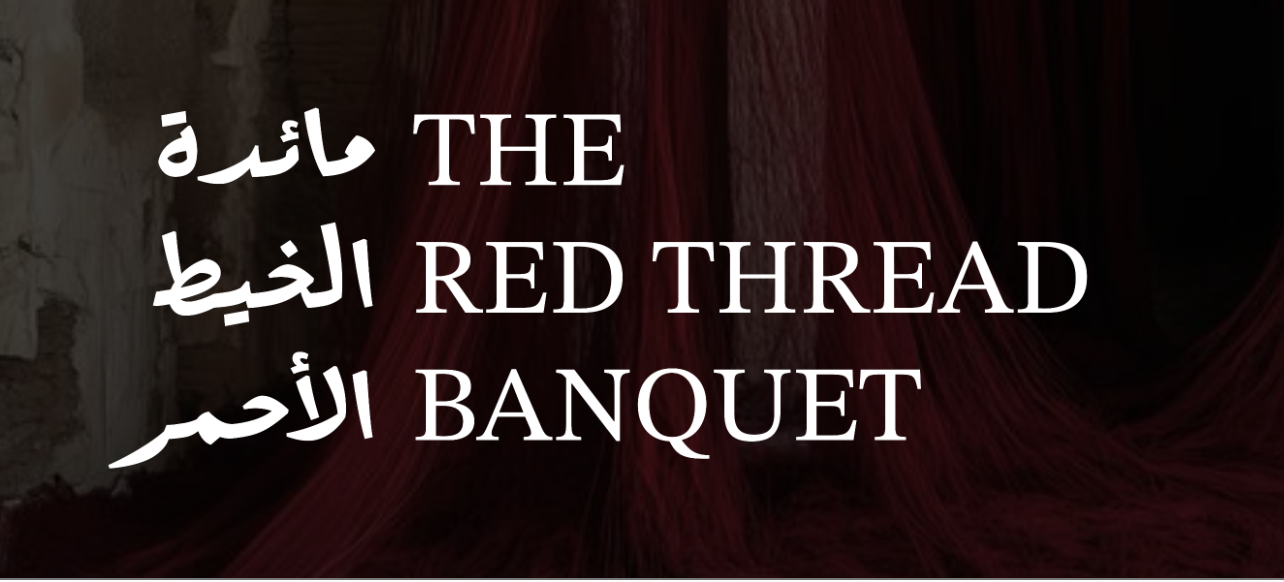
Episode 2 and 3 of this world are currently in the grant application phase, taking the form of a participatory installation exploring mode of myth-making across realms and temporalities (see: Borrowed Time) and a scalable, immersive dining experience centred around narratives of the feminine (see: The Red Thread Banquet).


ARDUNA (Arabic: "our land") is a participatory worldbuilding ecosystem for the SWANA region, operating across virtual, physical and social space. It functions simultaneously as a fictional world/alt history, a LARP that unfolds through live events and supper clubs, a worldmaking lab, and an evolving body of collective knowledge. At its centre is an attempt to re-originate the narrative of our being in the world: beginning from the region itself: its lands, languages, ecologies, histories, cosmologies and ways of knowing, and treating these as active worldbuilding systems. Rather than constructing one definitive alternative reality, Arduna creates conditions in which multiple worlds can be generated, inhabited, tested, altered and recorded.

It pulls from principles of alternate reality games, immersive theatre, and narrative design to present a series of live events and experiences that blend reality with the storyworld. It weaves culinary narratives, generative media, and episodio storytelling to explore themes of being, belonging, and origin stories. It tests practical modes of cultural production and the construction of a shared reality across timelines that may have existed, and may emerge alongside the current reality of the region. Arduna's worldbuilding will weave into/be supplemented by a series of workshops around indigenous 'Arab' narrative practices - a curriculum which I have already outlined.

CORE:

ARDUNA positions human, alongside non-human inhabitants that are not metaphors but vantage points from which relations become legible. It uses land and language as the anchor points for investigating current reality, and catalysts for reimagining it. Arduna's storyworld treats "land" as a dynamic relation rather than a backdrop, and language as a container for codes of consciousness, capable of catalysing various experiences of being'. It sets up a responsive world that audiences can simultaneously invoke and inhabit, guided by situated 'actants', where cuisines, scripts, sounds, and ecologies are evolving narrative forces. The aim is to counter imposed, inherited and internalised representations with tools that are made with and for the community that is cast into the storyworld. Through the episodic ''experiments'. It attempts to activate people into iterative, participatory worldbuilding by emphasising that a shared reality can be composed, as well as contested/critically examined throughout the process.

DESIGN PILLARS

  • Opt-in roles/tiered immersion: Arduna's design framework offers the storyworld to the audience through 3 levels of immersion, allowing varying modes and depths of engagement through different diegetic levels. It starts with the familiar before drawing them into the storyworld

  • Familiar formats: supper clubs, immersive installations, and interactive experiences form the live event series through which Arduna is experienced and the community begins to form, while the online presence offers storytelling through texts and a webpage.

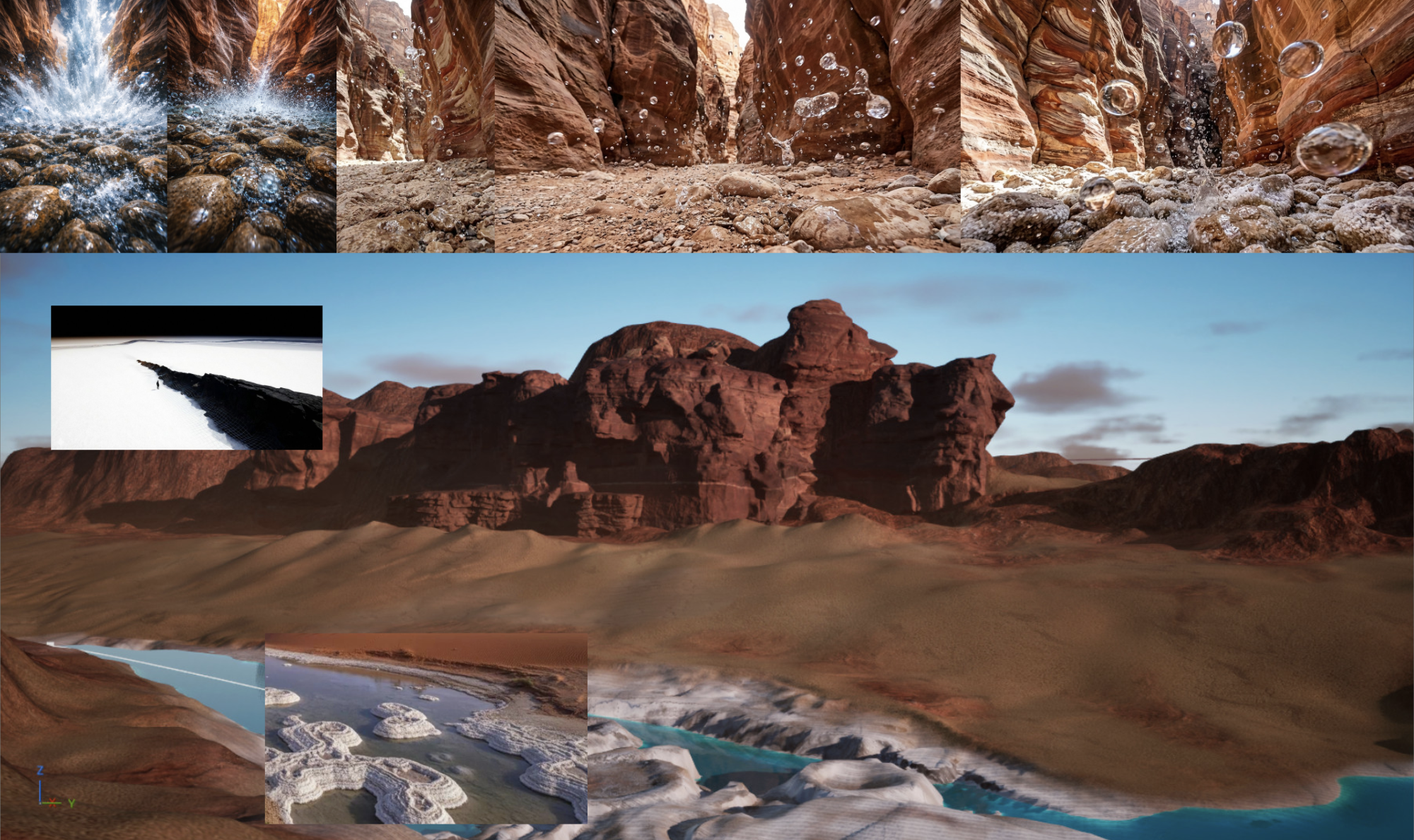
  • Situated narratives: oral histories, indigenous fictions, and procedurally generated/regionally accurate landscapes that are responsive, enable the storytelling to be situated in an undefined part of the region. R&D explores ethics of representation, tests balance of specificity vs ambiguity of location in suspension of disbelief, as well as experiments with stylisation to prevent the uncanny.

  • ARG + Game mechanics: the episodic experiences utilise game mechanics to draw participants into the world, with the goal of having each participant transition to an 'inhabitant' of the storyworld, capable of enacting change through clear narrative pathways and modes of agency depending on the parameters of each experience.
    Language as shared reality: a series of workshops on excavating through the Arabic language for encoded values shared across the Arabic-speaking world

  • Language as alchemy: investigating how particular uses of language (from ancient to current languages, as well as digital code) can 'shift reality', catalyse states of consciousness and allow access to different temporal experiences (here the study goes into current internet phenomena that are noted by various digital anthropologists examining Gen-Z language and digital esotericism practices).

  • Symbol & script lab: an expanding script and symbol system inspired by scripts across the Arab world, experimenting with neologisms, and letterforms that attempt to capture meaning beyond current language systems, or build on ancient languages that have passed through the region that possibly captured more expansive meaning that current languages no longer carry.
    Multiple perspectives: Arduna explores narratives from the POV of land, flora, fauna, and force/element.

  • Participatory making: recipes, walks, soundings, and micro-work-shops that invite communities and diaspora to co-author content.

  • Codes of conduct: One of the core aims is to develop a code of social conduct that is responsible and shared amongst partici-pants, that draws from the co-created storyworld, as well as experiences like LARP and immersive theatre, where physical and cognitive safety is taken into account

Its methodology moves continuously between knowledge-building and worldbuilding. Research into land, ecological knowledge, language, cultural practice, belief, memory and political history becomes material for speculative construction. Participants surface the narratives already organising a place or condition, examine which structures have been inherited, imposed, extracted or naturalised, and then intervene in them through speculative propositions and what-if forks. These interventions become worlding tiles: modular fragments that can alter Arduna's evolving narrative cartography. The atlas therefore behaves less like a representation of territory and more like a record of accumulated acts of worldmaking, where geography, memory, relations, power and possible histories can be rewritten through participation.

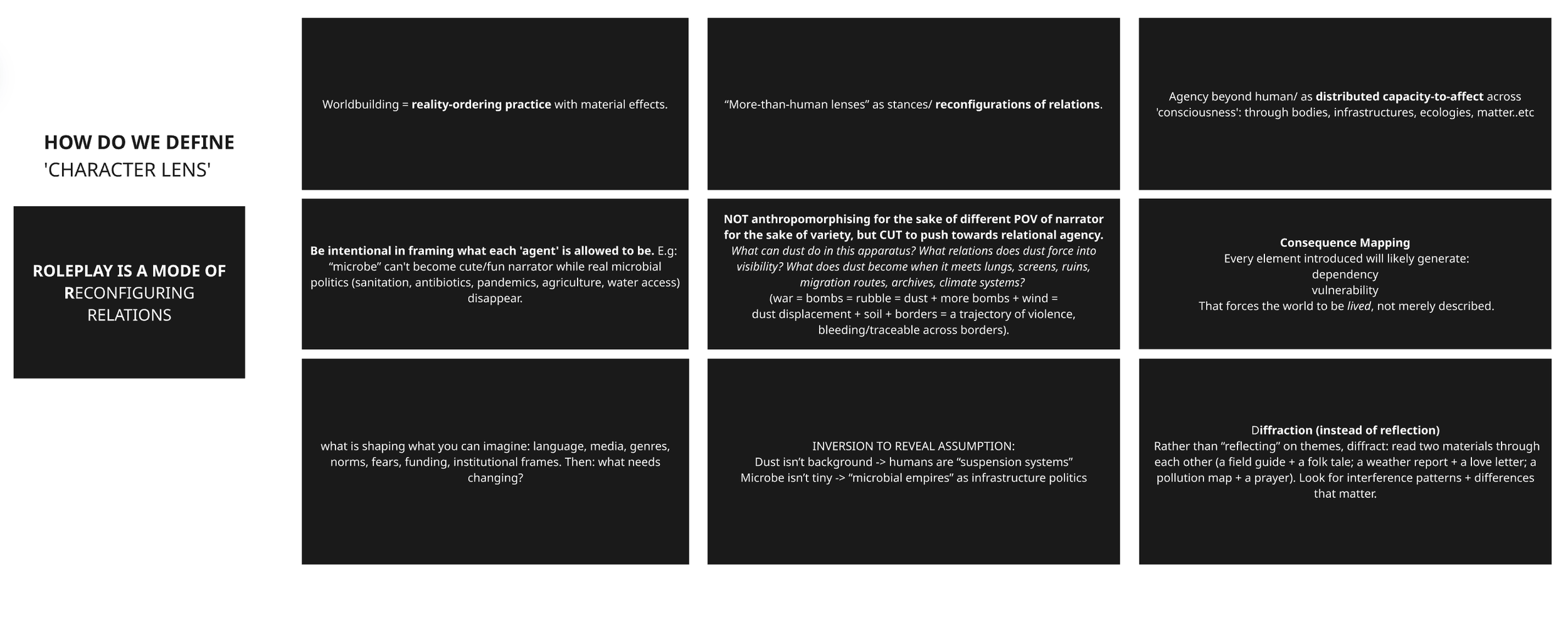
A key part of this process is the use of character-based narrative lenses. Participants do not have to encounter the world exclusively through a human protagonist. They can inhabit or think through flora, fauna, forces, elements, landscapes and adjacent or unseen beings, alongside human characters. A river, wind, olive tree, oryx or atmospheric force can become a position from which the world is perceived and acted upon. Each lens changes what becomes perceptible, what forms of knowledge are available, what relationships become possible and what actions make sense. Character therefore operates as a kind of narrative and epistemic filter: changing the observer changes the world that can be produced.

The ecosystem is activated publicly through workshops, live events, participatory installations, immersive dining, role-play and other collective worlding formats. These are spaces for testing Arduna's methods rather than simply presenting a finished fictional universe. Participants might work through a character lens, examine a particular ecology or narrative structure, construct an alternate history, respond to a rupture in the world, or collectively negotiate the conditions of a possible future. Outcomes from these encounters can subsequently enter the wider Arduna system as stories, rules, relationships, artefacts or worlding tiles. The public therefore contributes to the development of the world and to the knowledge archive from which later iterations emerge.

Underlying this is the idea of the assemblage. Arduna looks at worlds as consequences of particular configurations of people, institutions, materials, technologies, beliefs, environments, histories and forms of power. Certain assemblages can produce conditions of violence; altering even part of that configuration may allow a radically different world to emerge. The methodology can therefore work with existing condition, asking what relations and decisions allowed it to come into being through alternative variations. Speculation becomes a way of examining causality: which elements need to be removed, introduced, reconfigured or related differently for another reality to become possible.

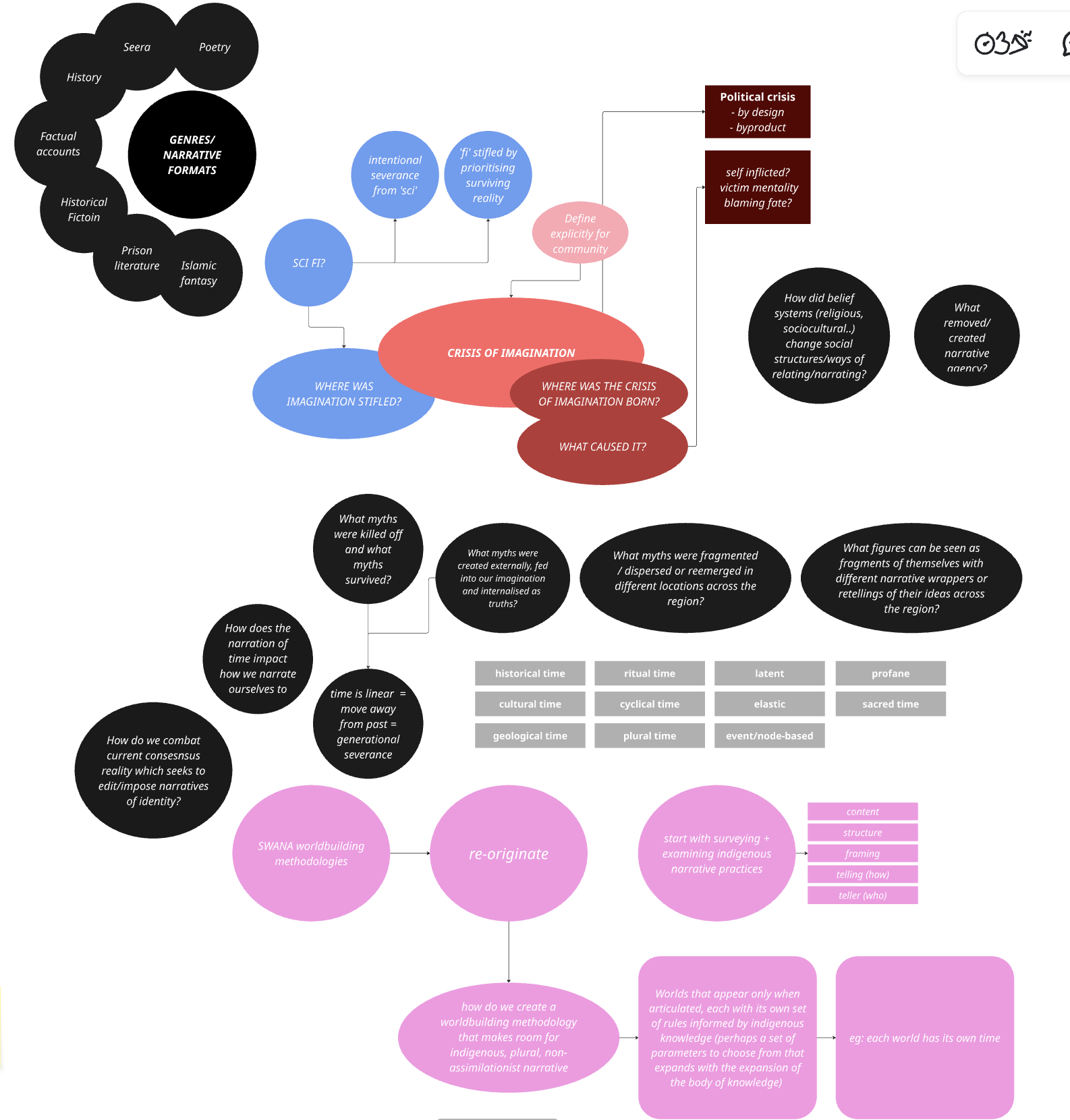
This gives Arduna its temporal structure of editable pasts, parallel presents and plausible futures. The past is treated as something whose consequences can be revisited through counter-history and speculative intervention; the present can contain several simultaneous versions of reality depending on the relations through which it is experienced; and futures emerge from trajectories already latent within those altered conditions. Past, present and future continually feed one another rather than sitting in a fixed sequence. Across Arduna, worldbuilding becomes a method for asking how worlds come into existence, who and what participates in producing them, how violence becomes structurally possible, and what different assemblages might allow other worlds to be rehearsed into being.

Bint al-Kawaneen: The Winter Winds Series

My research into worldbuilding over the past two years has been expansive, but focused on the ways in which people in the SWANA - and particularly Bilad al-Sham - have narrated their worlds and their place within them. Part of it took me into weather lore, and how traditions and practices stem from similar sources of knowledge, but vary from region to region, and encode different atmospheric phenomena into place-based narrative practices that are informed by the different cultures and ecologies.

Earlier this year, I was delving into the worlds of thinkers from other parts of the world, whose practices emerged from other realities. I was becoming increasingly curious about where the decision of what counts as ‘real’ came from, and what happens when that decision looks like if it came from alternate perspectives within that same world, and how that changes the way things are narrated, enacted, exchanged and negotiated, and how they are anticipated when the very definition of language changes with that perspective.

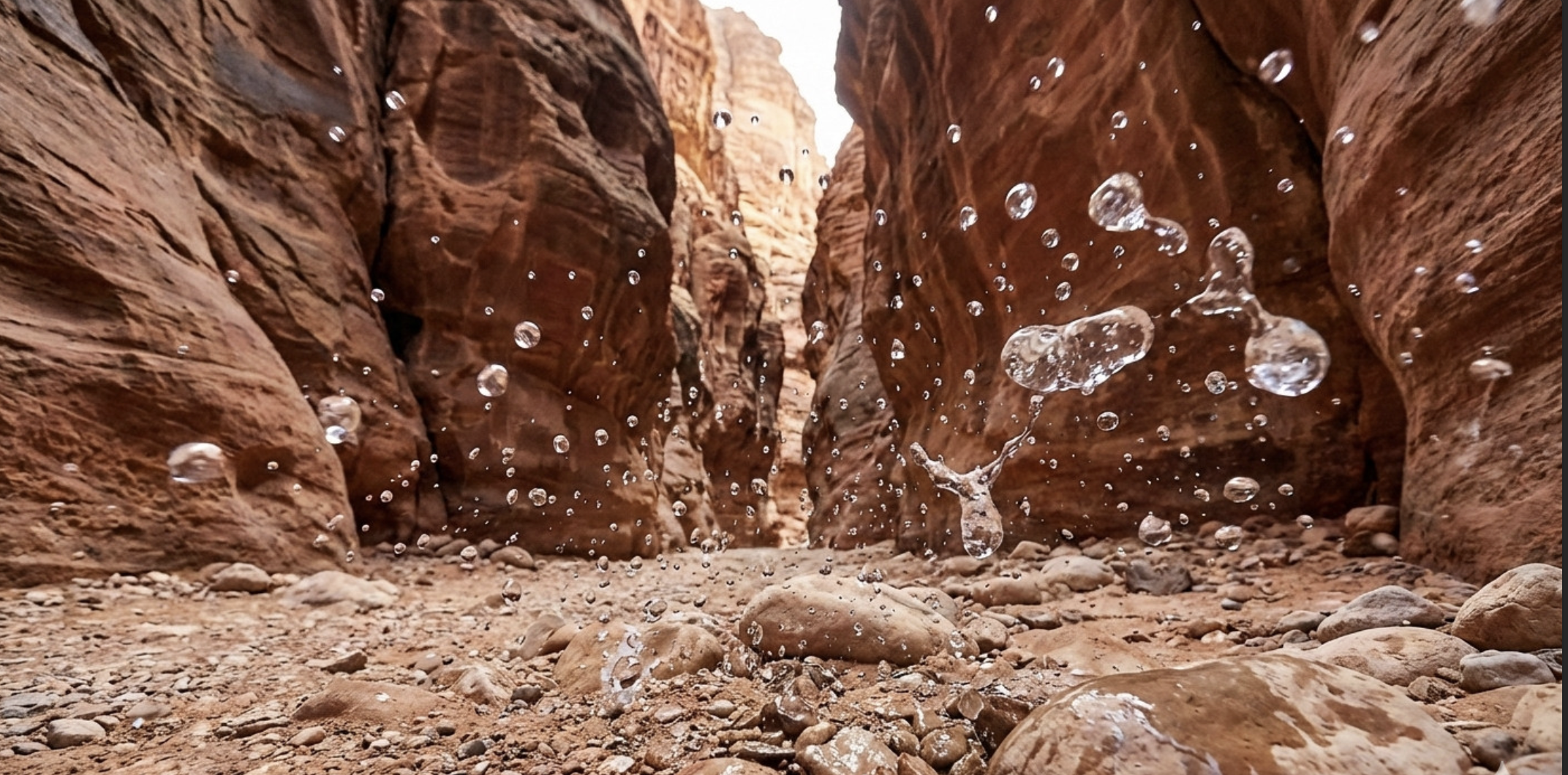
That led me to thinking about water, as the medium, the mediator, the source and the signal that moves through the different layers of the cascading wdrldbuildling system that I was beginning to observe. I started with the politics of water, its relationship to the terrestrial, the spiritual, the celestial, and to time. I started by looking at places like Batir, a village in Palestine whose residents decided that in ‘water time’, a week has 8 days, to enable the 8 families of the village to each get a day of water supply. I looked at rain prayers across Bilad al-Sham, with beliefs that breath carries intention from the spiritual - via the corporeal - through condensation to reach the cosmic, negotiating the anticipated downpour through the atmospheric, and finally back down to the terrestrial. 

That is where my curiosity became anchored to the Marbaaniyeh: the first wind of winter in Shami lore. She became an entry point into a much larger system of environmental knowledge: the accumulated ways people in Palestine and the wider Bilad al-Sham have read the atmosphere, land and sky in order to understand what kind of season might be coming. My research moved through Palestinian weather sayings and proverbs, agricultural calendars, the observation of winds, clouds, rain, frost and celestial movements, and the use of plants and animal behaviours as environmental signals. I became interested in how these different forms of observation operate together: how knowledge is built through repeated, situated attention to changes in the land, and how that knowledge passes between generations through agricultural practice, domestic preparation, sayings, stories and embodied experience.

I looked at practices through which life within areas of Palestine persists through a sensory and relational understanding of the environment. Ones that moves, connecting realms, weaving through past, present and future in temporalities that differ from the accelerated versions imposed by colonialism and capitalism. It became apparent that ecological knowledge wasn’t limited to the ecological, extending through relations between bodies, materials, landscapes, celestial phenomena and inherited practices. In the same vain, a community or village organises itself around these phenomena, which become narrative substrates that shape social imagination, which then in turn ensures that certain practices continue to be enacted.

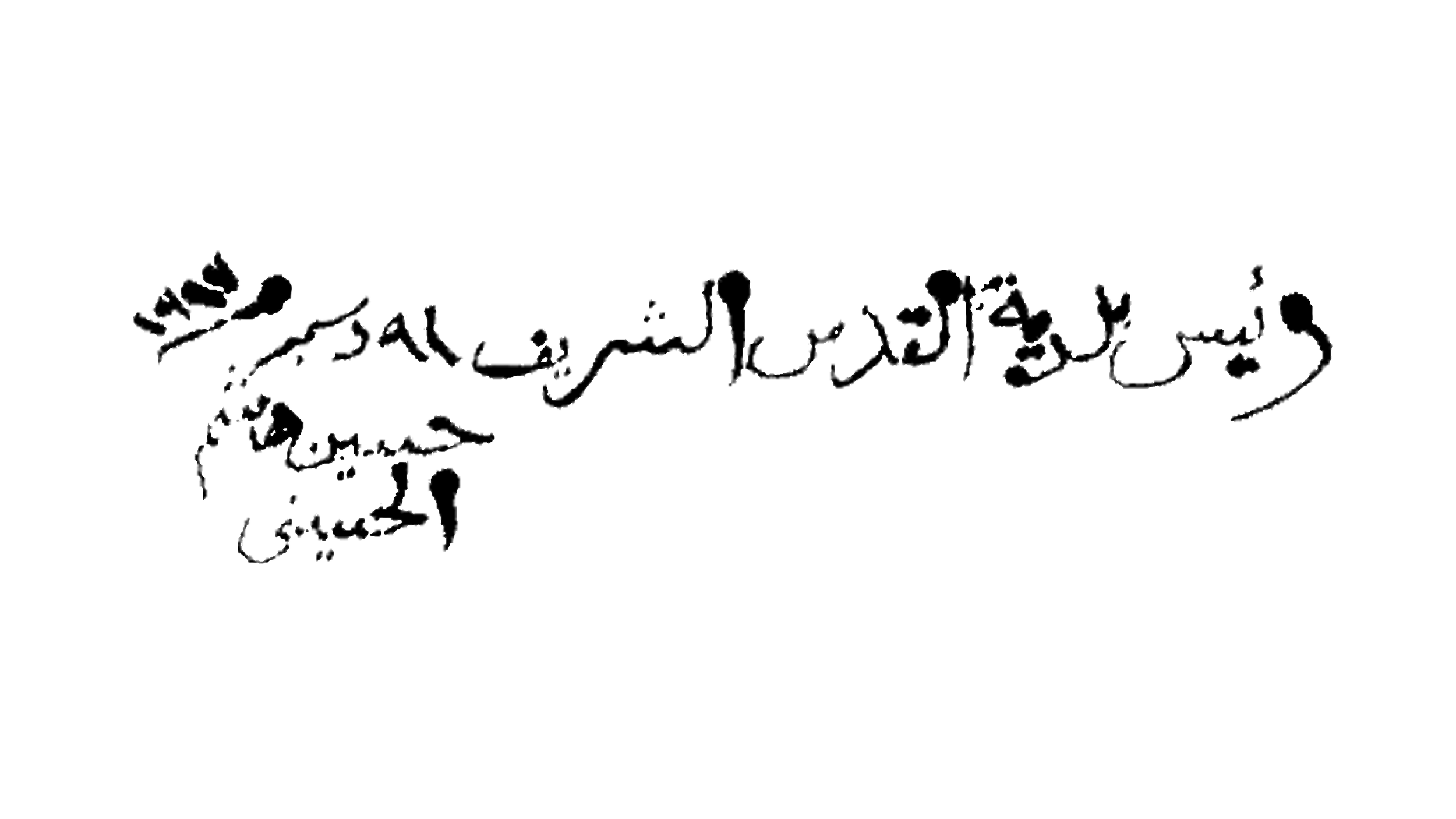
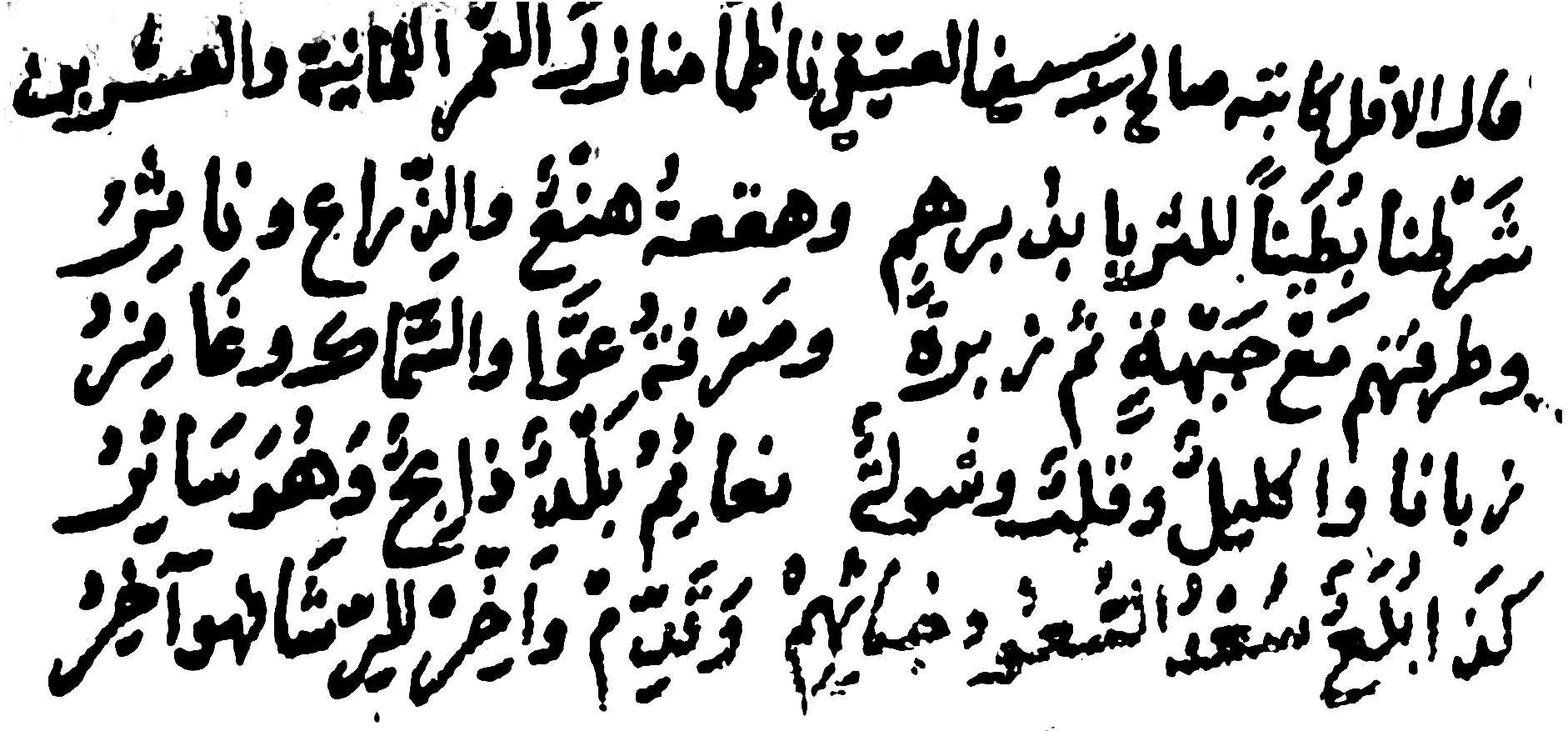
تاريخ النظم: ١٢٢٢ للهجرة / ١٨٠٨م - المؤلف: الشيخ الشاعر صالح بن سيف العتيقي- نظم منازل القمر الثمانية والعشرين

That led me back to Tawfiq Canaan, particularly his work on Palestinian seasonal folklore and plant lore. In the material Canaan recorded, agricultural knowledge is transmitted through repeated observation, sayings, participation and story. The direction in which rain travels can carry meaning; constellations help situate the agricultural season; the appearance of animals after heavy rain becomes an environmental sign. Children learn by accompanying adults into fields, participating in harvests and repeating the sayings that organise seasonal knowledge. Canaan also recorded Palestinian practices for periods when the expected relationship between people, land and weather broke down altogether. During drought, rain-seeking processions included songs and communal appeals for water, sometimes involving the figure of Um al-Ghaith, the Mother of Rain. These practices brought prayer, performance, collective responsibility, agriculture and atmospheric uncertainty into the same system. 

Alongside this were forms of practical forecasting that treat the surrounding environment as a distributed field of sensors that inform systems of inherited observation. Through naming and narrative wrappers, they' are preserved and relayed generationally, continuing to carry forward an extraordinarily dense heritage that has accumulated through direct encounter, without the need for, or reliance on  scientifically verified modes of forecasting. 

What continuously caught my attention was the relationship that these practices imply. Weather, for example, is never read as a single abstract number narrated from the POV of a human with knowledge certified by an institution. Through these practices, the materiality of the land became the narrator on which communities relied. This took on different forms, from salt piles that dry differently according to humidity, a plant growing if enough moisture is in the ground, or certain types of birds arriving when certain weather conditions are present. Observing the world around them is a form of forecasting, and agricultural decisions are arrived at through various kinds of evidence from a dispersed network of bodies - plants, animals, soil, atmosphere, celestial movement - interpreted through inherited memory and communal knowledge.

Raja Shehadeh’s writing fed into this part of the research from another direction. Palestinian Walks describes a landscape of terraces, springs, paths, olive groves, valleys and old agricultural structures whose meanings emerge through movement and familiarity, and whose narratives are anchored spatially. Scholarship on Shehadeh has described this as a Palestinian practice of place-making in which knowledge of land is carried through names, routes and landmarks. It helped me think about land as a segment of a world only truly legible from within, and only to what is sustained/reciprocal.

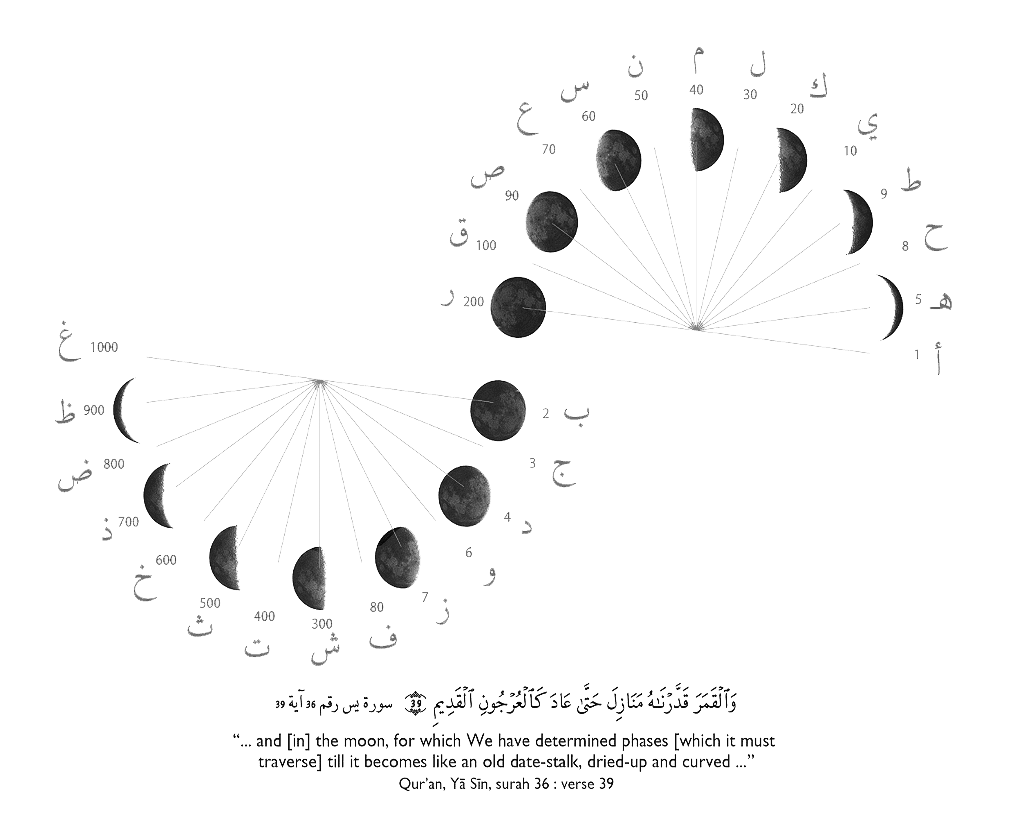
The research then extended upwards into the celestial. Pre-modern Arab systems of anwa’a and the manazil al-qamar, the twenty-eight lunar mansions, connected celestial observation with the passing of seasons, weather and agricultural time. Jordanian astronomical accounts still describe the older practice of identifying periods of cold, heat, sowing and harvest through the rising and setting of stars, and the broader history of Arab star knowledge also has stars functioning as seasonal and navigational markers, making the sky simultaneously a clock, calendar and means of orientation. 

From there I arrived at the lunar mansions as something more operational. Research by Daniel Martin Varisco on the section of the Shams al-Maarif devoted to the manazil al-qamar examines a twenty-eight-part lunar system in which each station carries prognostications and astrological or mystical associations. Importantly, the surviving version he analyses is a seventeenth-century manuscript attributed to al-Būnī, so I have been careful not to treat every element of the received Shams al-Maarif as securely authored by the historical thirteenth-century al-Buni. What interested me here was the structure itself: celestial position establishes conditions; those conditions alter what actions are possible or advisable; particular moments have different potentials, restrictions and consequences. 

Gradually, all of these things began to look like extensions of the same world/ystem, observed at different scales, and from different perspectives. The plant, the proverb, the star, the salt, the migrating bird, the rain procession, the stored food, the planted terrace, the fros, and the placement of the moon all offer different interfaces through which a community interprets and negotiates the conditions of its world. Some belong to practical environmental observation, some to oral history, some to religious or spiritual practice, some to celestial systems, and some move between several of those registers. Taken together, they describe a reality produced through relations between the terrestrial, ecological, hydrological, atmospheric, celestial, social and spiritual.

This is where the Marbaaniyeh began to change within my own worldbuilding. I started treating her as an atmospheric consciousness - a kind of reality machine whose arrival establishes the conditions under which the village’s next world can exist. Wind, rain, frost, water, soil and temperature determine what germinates, what fails, what is preserved, what is damaged, which animals endure, what can be planted, and eventually what can be eaten. In that sense, she decides what survives and what does not. The farmer’s position is one of uncertainty and negotiation: trying to anticipate how she will arrive by reading signs, remembering what has happened before, listening to other people, preparing the land and household, and choosing how seriously to take the different forms of knowledge available to them.

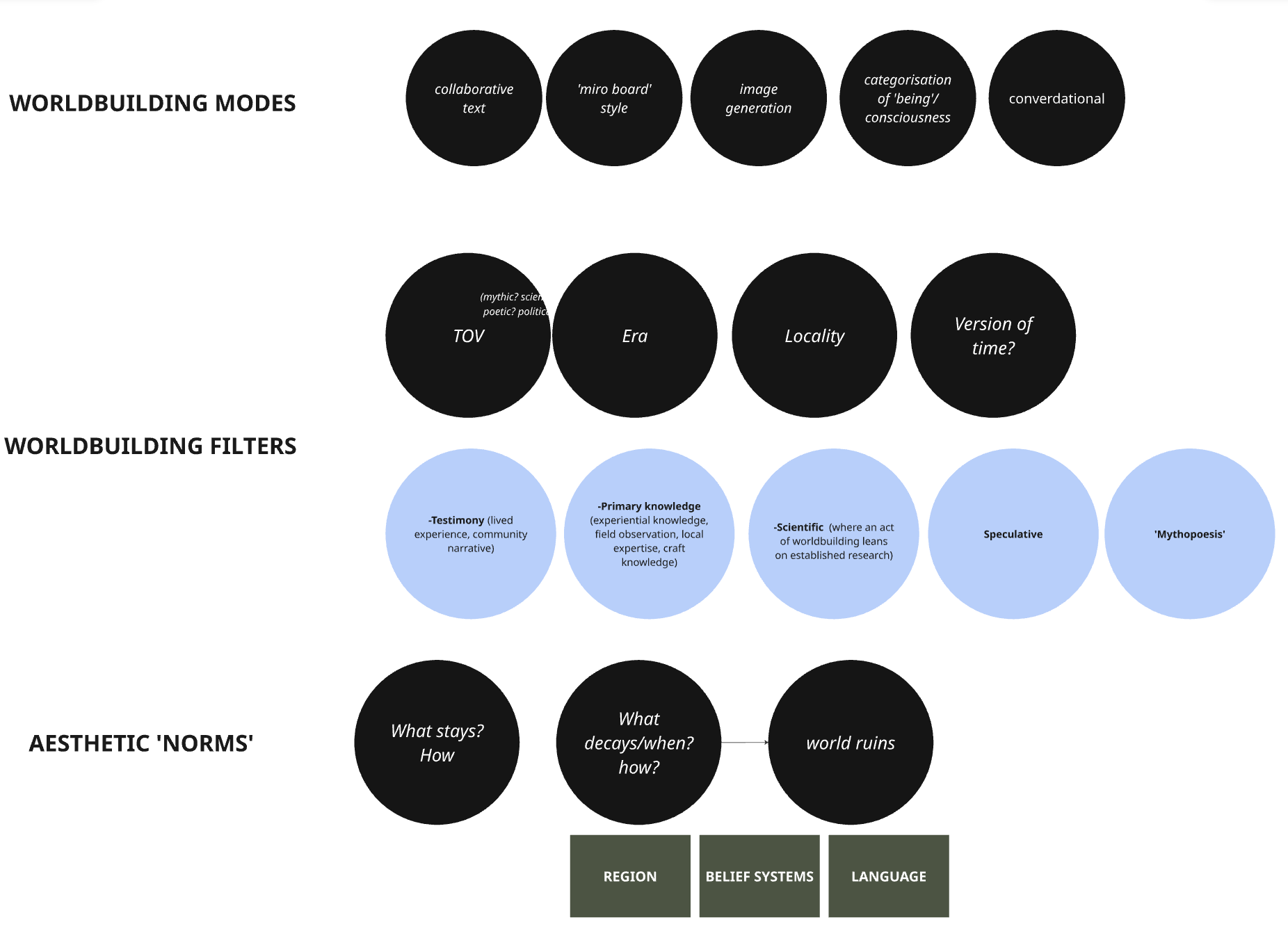
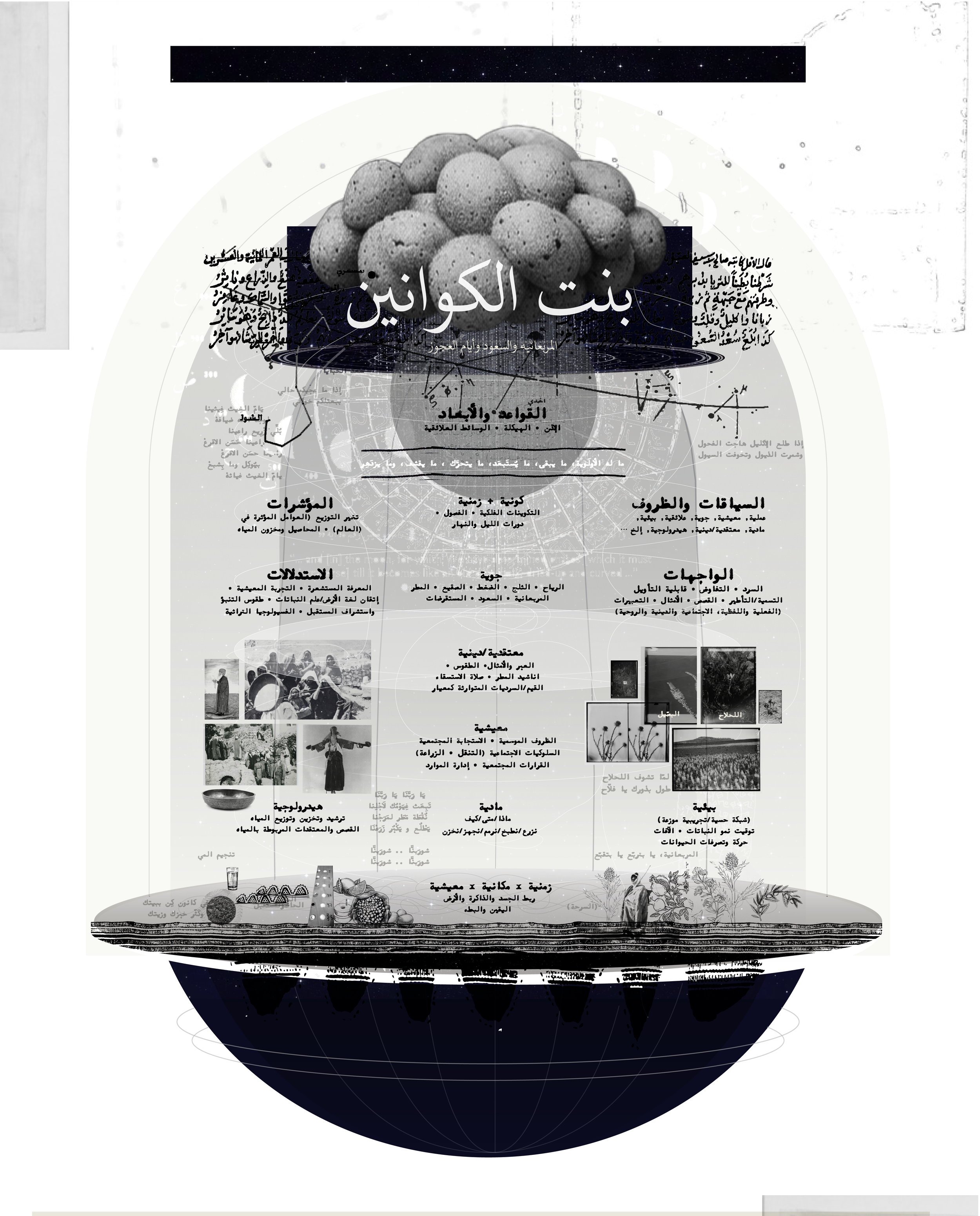
I began diagramming this worldbuilding system: What/who can sense the state of the Marbaaniyeh? What signals does she produce? Who interprets them? What interfaces do humans have with land, weather and the cosmos? What forms of preparation are possible? Where do individual and communal decisions diverge? How does information pass between generations, but also between humans and their kin? How do modes of communication move between planes? What counts as success or failure? What changes in the world as a consequence?

Al Marbaaniyeh - diagram of cascading worldbuilding - © 2026 Yasmeen Ayyashi | Local Narratives Ltd

Agricultural preparation, domestic preparation, food preservation, storytelling, sayings, songs, ritual, celestial observation, modern meteorological information and inherited environmental knowledge all became possible modes of action. The point was never to establish which tradition could perfectly predict the weather. The system became interesting precisely because everyone is acting under uncertainty, with different kinds of partial knowledge, while the consequences are shared.

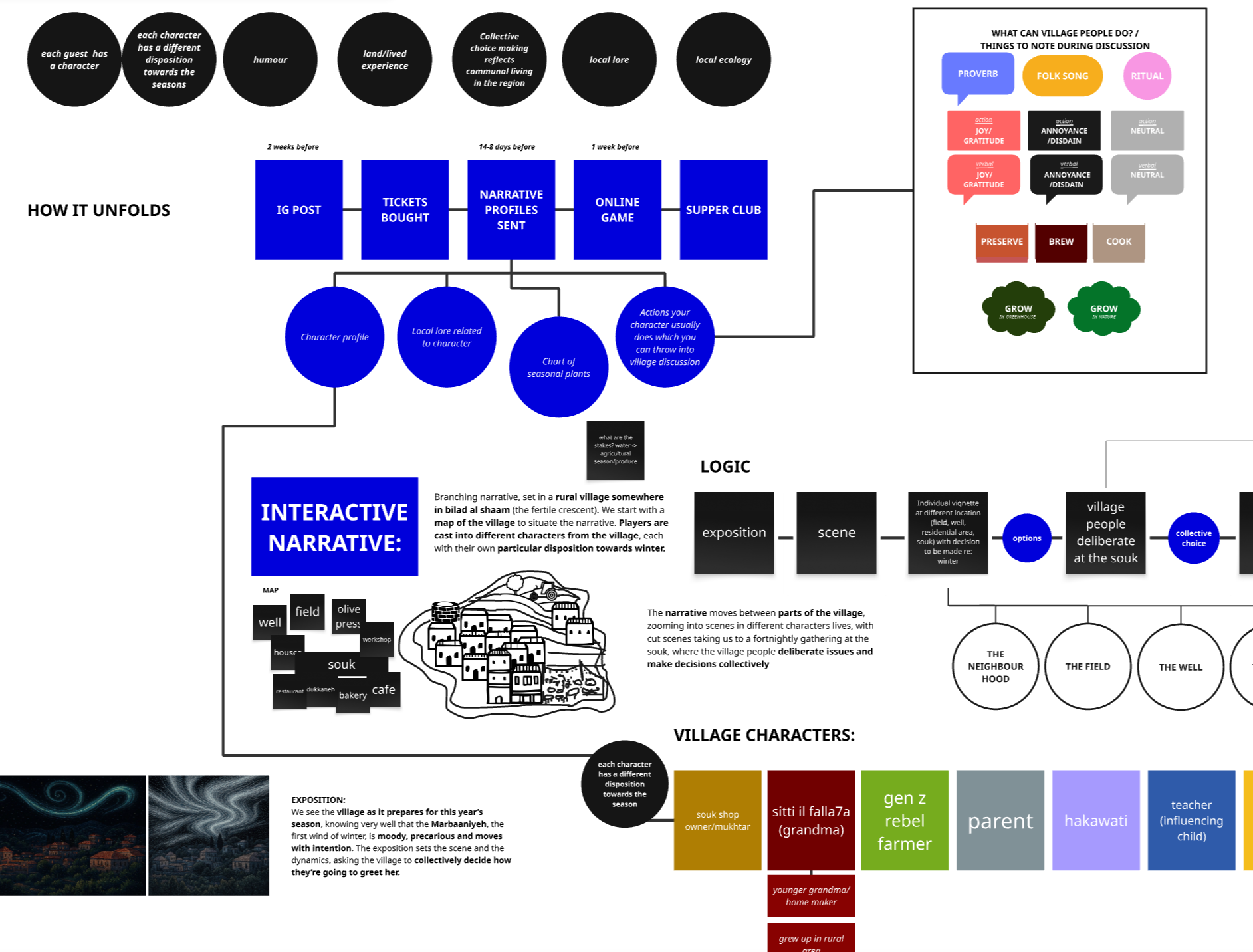
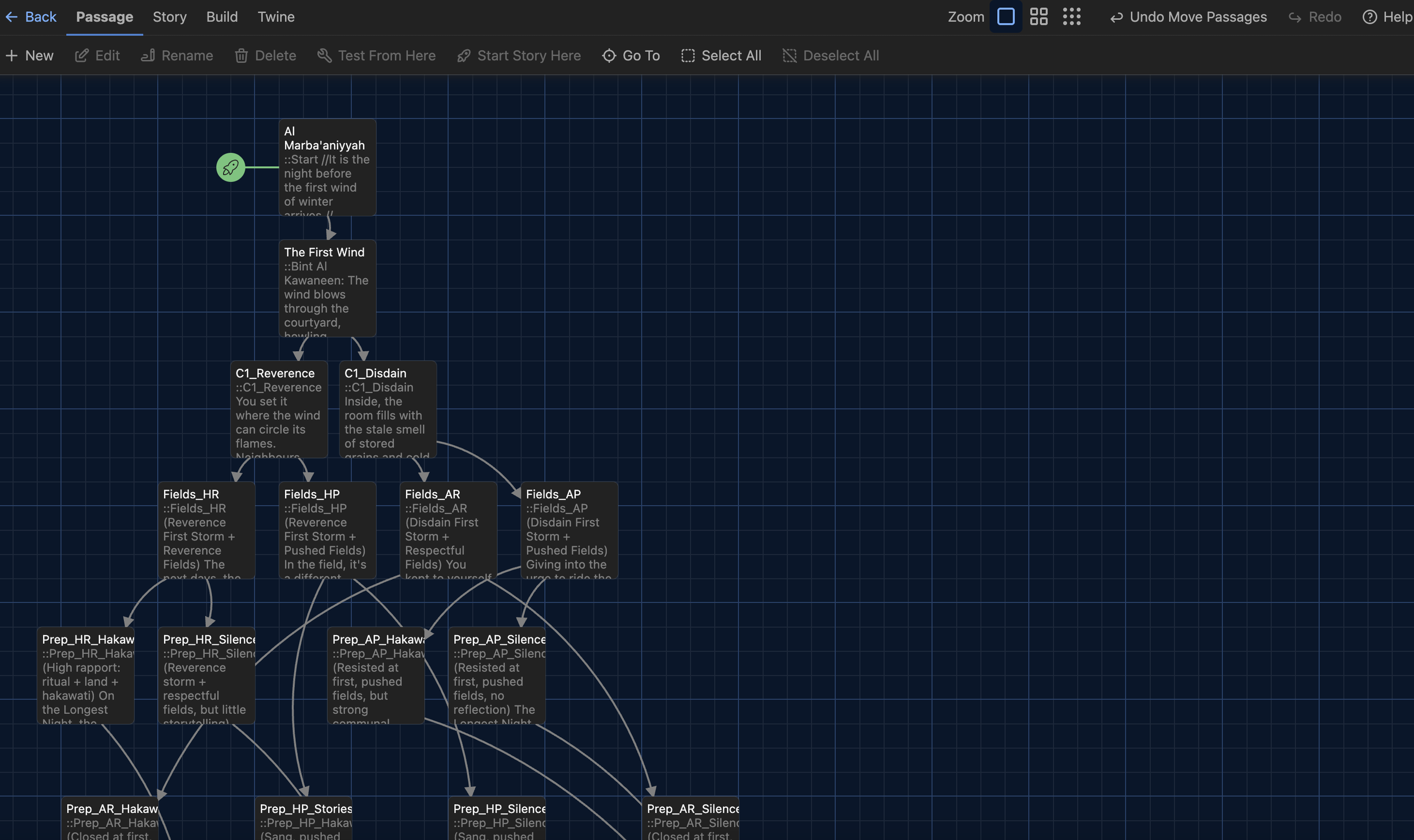
Narrative branching in Twine - © 2026 Yasmeen Ayyashi | Local Narratives Ltd

Once I had mapped it in this way, it became increasingly clear that I had inadvertently constructed a narrative system. I am now converting that system into a game played online by twelve guests, ten days before the physical supper club. Each guest is cast as a character living in an unnamed village in Bilad al-Sham, with a particular age, profession, demeanour, attitude, set of relationships and hidden agenda. Across the session they have to make decisions both collectively and individually as the Marbaaniyeh approaches: how to prepare the land and household, which signals to trust, what to preserve, when to plant or hold back, how to respond to warnings, whose knowledge to listen to, and whether to draw on sayings, songs, lore, agricultural practices, domestic behaviours, ritual or newer forms of prediction. Their decisions alter the state of the village and its agricultural year.

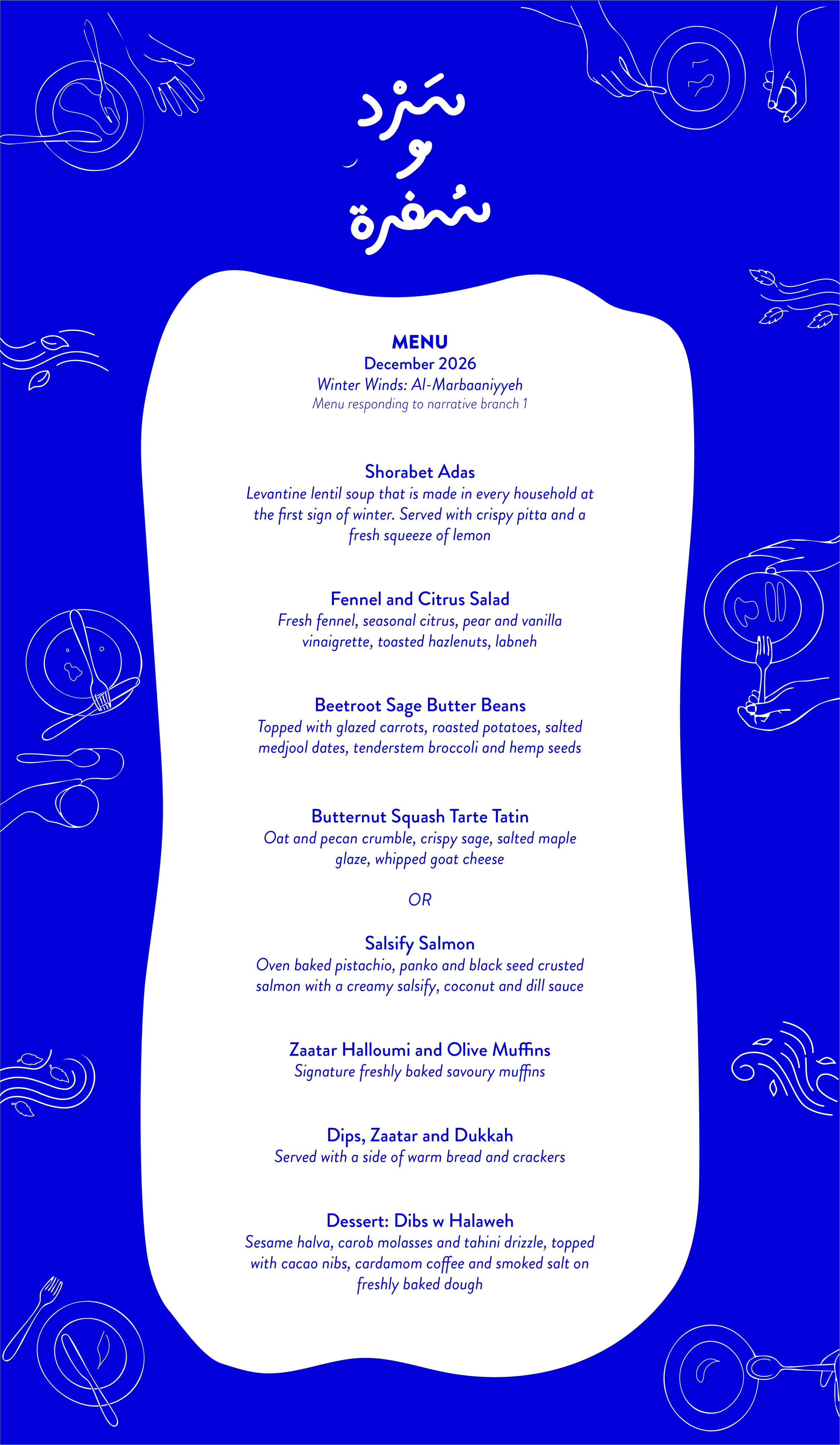
The harvest produced by that game becomes materially consequential. Ten days later, when the same group arrives for the supper club, the outcome of the simulated agricultural season determines the menu they are served. What they managed to grow, preserve, protect or lose during their negotiation with the Marbaaniyeh shapes what can appear on the table. The meal therefore becomes the final state of the world they made together: an edible consequence of decisions taken across different kinds of knowledge, competing priorities and relations with forces that none of the characters can fully control. 

The wider intention behind Winter Winds is to surface forms of worldbuilding that already exist within SWANA cultures. I am interested in worldbuilding as something that can emerge through long relationships with land, weather, plants, animals, stars, spiritual practice, language, memory and communal behaviour. The human occupies one position inside that network. The process of ‘worldbuilding’ - or producing the conditions of the world - is distributed across the ecological, terrestrial, celestial, atmospheric and unseen, and the world is continually enacted through the relations between them. The village cannot create its reality alone. However, it can observe, interpret, prepare, remember, cooperate and attempt to negotiate with everything that shares its reality. Worldbuilding, here, becomes a communal practice of narrating reality, and actively sustaining it/creating it alongside everything that has been narrated as ‘real’, across land, kin and cosmos. 

Sard w Sufra sample menu - The Winter Winds Series - © 2026 Yasmeen Ayyashi | Local Narratives Ltd

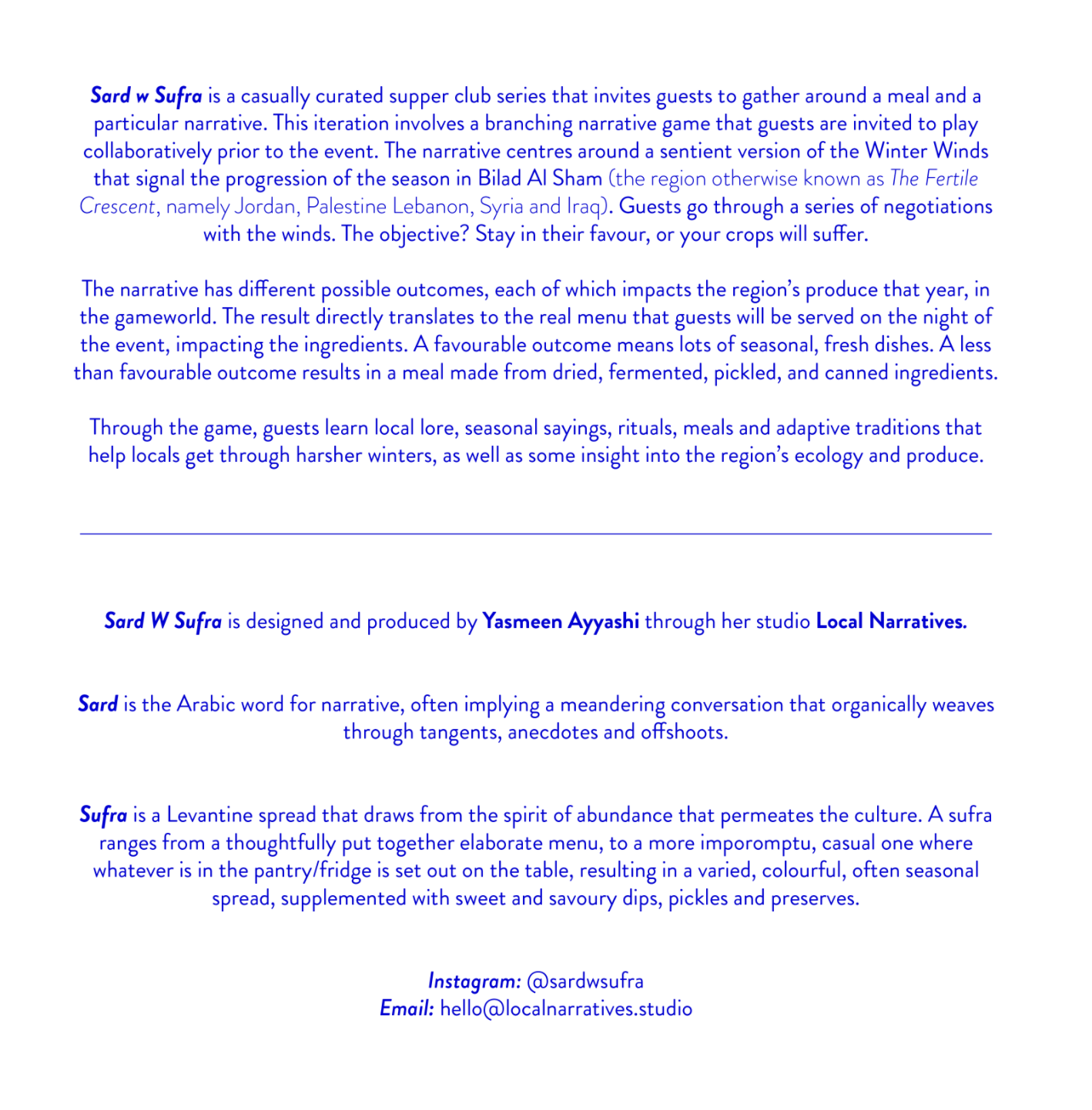
Sard w Sufra - © 2026 Yasmeen Ayyashi | Local Narratives Ltd